
The essentials
The strength index is guidance based on available data, not a win probability or proof of individual skill. A balance alert does not replace an assessment of the actual round.
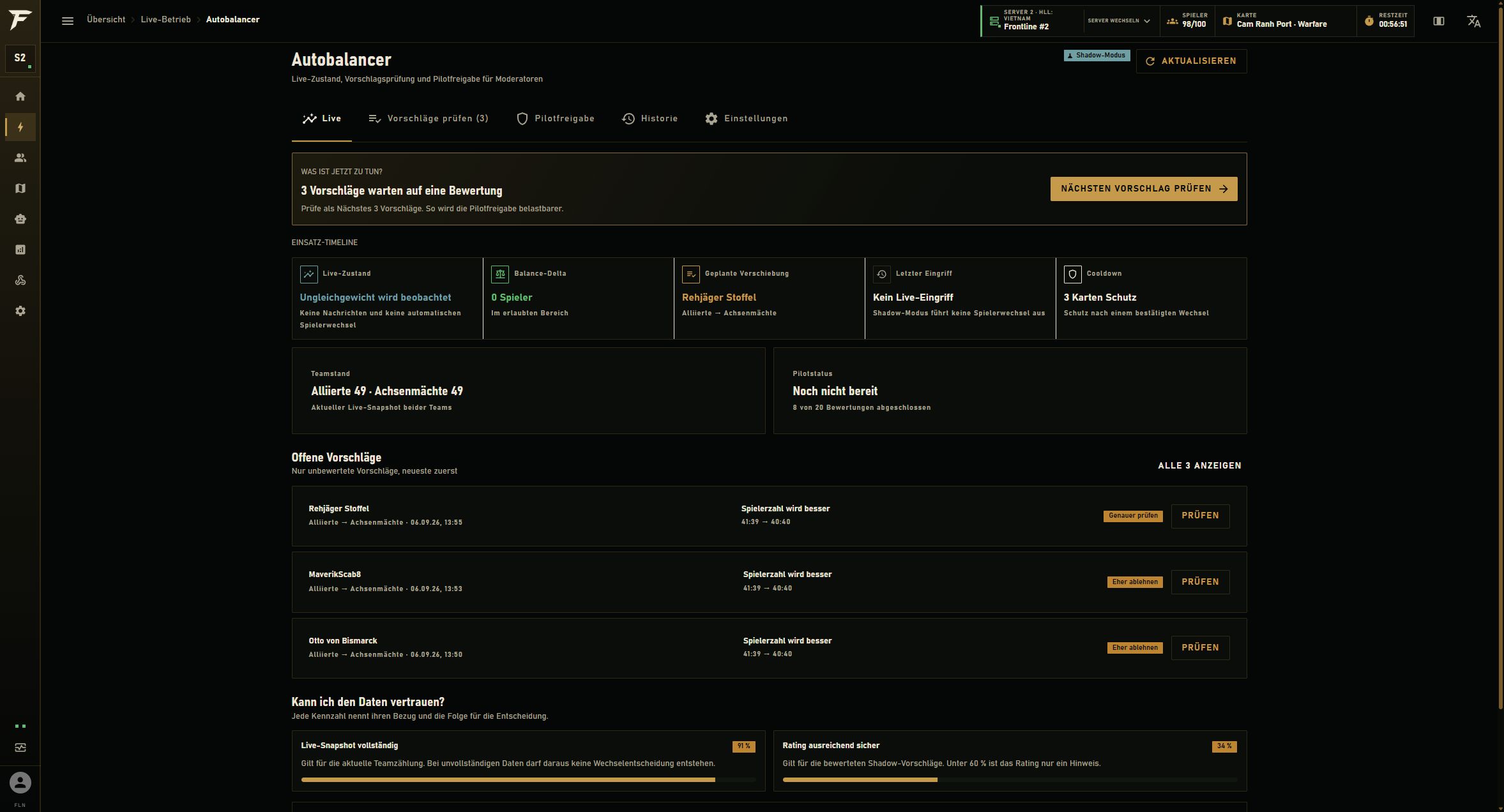
More than matching player counts
Team size answers just one question: how many players are on each side? Experience, identifiable leadership and squad composition can also matter in practice. Frontline CRCON can combine that available team structure into an understandable assessment.
An estimate is only as useful as its underlying data. Missing, stale or incomplete information must not be treated as certainty. Check freshness and data coverage before acting on a recommendation. The system cannot know how a round will develop in the future.
From an alert to a deliberate intervention
A useful workflow begins in the live or team view: which server is selected, how large is the imbalance and what supports the assessment? Next, review the proposed move and its expected effect. An intervention should improve the actual problem, not merely change a number.
Illustrative example: both teams have the same number of players, but experienced leaders are concentrated on one side. A player-count-only balancer would see no difference. Staff can examine team structure and, where appropriate, ask for volunteers. Whether a move makes sense depends on the actual round, not on this example.
Consider squads, exemptions and protection periods
Pulling individual players out of functioning squads can disrupt communication and cooperation. Frontline CRCON can consider whole squads or suitable groups where free slots, team sizes and current composition permit. A joint move cannot be guaranteed in every situation.
Check protected or exempt players and configured protection periods. Repeatedly moving the same people within a short time would be difficult for them to understand. Exemption rules should be known internally rather than improvised during a live disagreement.
Observe first, then enable gradually
Initially use observation or shadow mode where your installation provides it. Staff can learn how recommendations behave without immediately turning them into automatic transfers. Compare suggestions with your own observations across different rounds and server occupancy levels.
Then choose the operating mode and approval rules that suit your community. Change one setting at a time where possible. Seeding or organised events may need different treatment from normal play. Universal thresholds would not be responsible without knowing your rules and data.
Inform players and check the outcome
Prepare a short message explaining the reason and process for a team change. Depending on configuration, the community can ask for volunteers first. Avoid language that labels affected people as weaker players: a team move is an organisational measure, not a personal judgement.
After an intervention, review team sizes, composition, new alerts and feedback from those involved. Use the action log for the follow-up discussion. A more even balance may help, but it does not guarantee longer rounds, happier players or a particular match result.
Your team checklist
- Freshness and data coverage checked
- Recommendation reviewed in the context of the round
- Squads, exemptions and protection periods considered
- Operating mode and approval rules clearly defined
- Players informed and outcome reviewed
Frequently asked questions
Does the autobalancer move players immediately?
That depends on the operating mode and configuration. Observation and shadow modes support reviewing data or recommendations. Before activation, staff should explicitly decide which actions may happen automatically and which require approval.
Does the strength index predict the winner?
No. It summarises available information about current team composition. Tactics, communication, the course of the map and incomplete data limit its meaning. A specific probability of victory cannot be inferred from it.
Will every squad stay together?
Squads or suitable groups can be considered. Available slots, team sizes, exemptions and the current game situation may prevent a complete squad transfer, however. An unconditional promise would therefore be misleading.
Does this apply to HLL: Vietnam too?
The same principles apply to supported HLL: Vietnam integrations. The data and actions actually available depend on the particular interface and installation and should be checked before activation.
Based on the published Frontline product description. Actual features depend on the game, interface and installation. Check the current offer for pricing and contractual services.
Current offer at FLN